ERP Explained: What It Means, How It Works, and Why Your Business Needs It
“Your business may be growing, but your systems could be slowing it down”
As operations expand, a lot of Qatar startups and SMEs start bumping into disconnected data, delayed approvals, messy stock counts, and reports that never quite match reality.
In the end, it burns time, adds cost, and makes growth harder to manage.
This is where ERP becomes useful.
Do you know? When companies use an integrated management system, they can lift operational efficiency by as much as 23%, so teams move quicker with fewer slip-ups.
Still, many founders do not fully grasp the ERP meaning or how it actually supports day-to-day operations, every single week.
Are you asking:
- Why do departments show different numbers?
- Why are reports taking so long to prepare?
- Why do stock and sales records mismatch?
- Why is business visibility becoming difficult?
Well, this insightful guide explains everything and shows how BRQ a trusted ERP implementation partner in Qatar is solving these challenges.
What Is ERP, and What Does ERP Meaning Actually Include?
ERP stands for Enterprise Resource Planning.
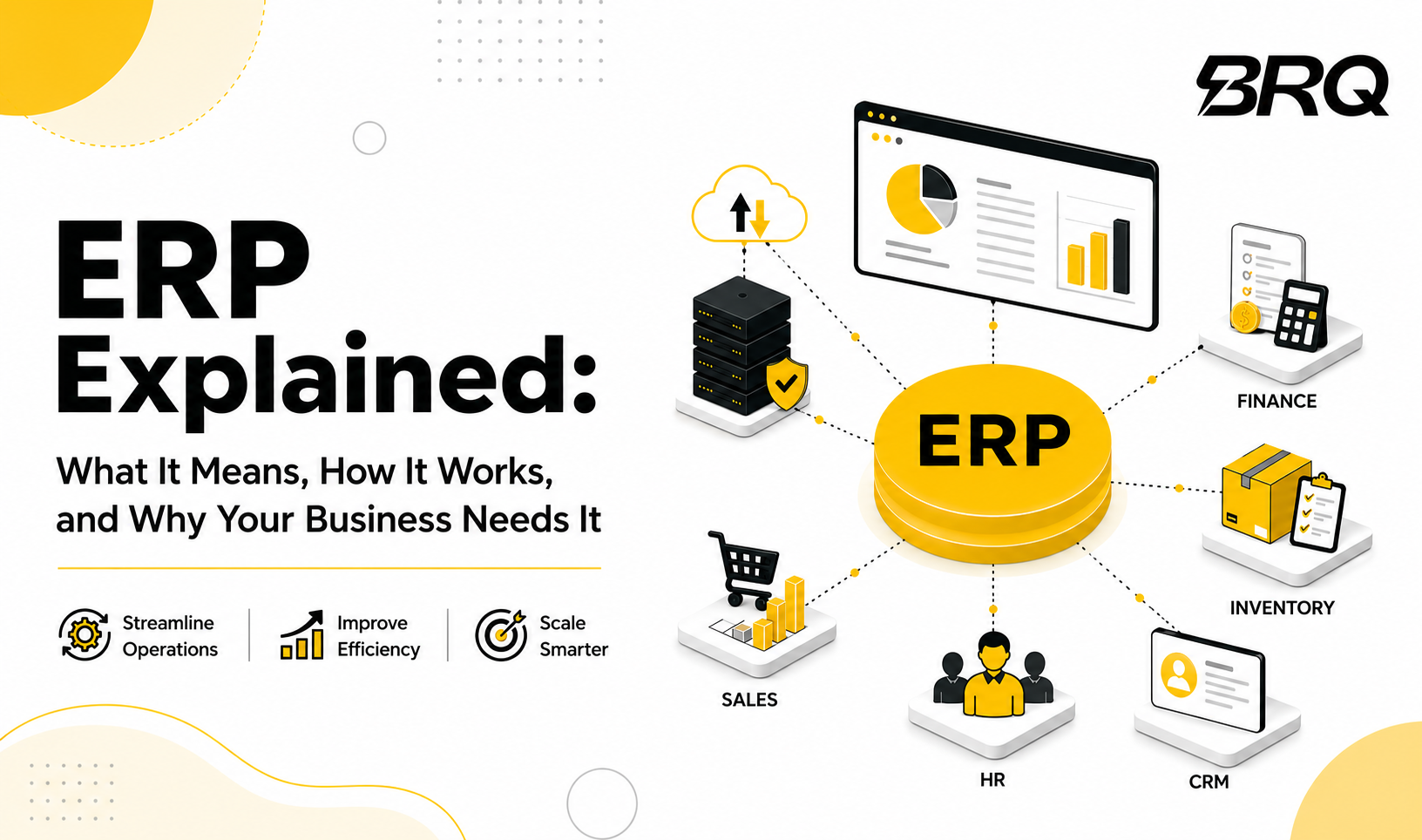
An enterprise resource planning ERP system connects key business areas like sales, inventory, finance, HR, purchasing, and reporting into one shared system.
Instead of five teams working from five different files, everyone works from the same live data.
ERP Basics
An ERP usually manages:
- Sales orders
- Inventory
- Purchasing
- Accounting
- HR records
- Customer data
- Reports and dashboards
Here is the simple version. When a customer order is entered, the system can update stock, create an invoice, notify finance, and show the result in a dashboard.
That is real ERP knowledge: one action should support the next task without making staff chase updates.
How Does an ERP System Work Behind the Scenes?
An ERP system works by using one central database for daily business operations.
When one department updates information, other connected departments can see that update in real time.
A normal workflow may look like this
- Sales enters a customer order.
- Inventory reduces stock automatically.
- Purchase alerts show low stock.
- Finance receives invoice details.
- Management sees updated sales reports.
For a Qatar distributor, this can stop a common problem: selling items that the warehouse no longer has.
For a clinic, it can connect appointments, billing, patient records, and follow-ups.
A good ERP application usually covers:
- Sales management
- Stock control
- Procurement
- Accounting
- HR
- Customer records
- Management reporting\
At BRQ, your official Odoo partner in Qatar, we help businesses map these steps before software work starts. The system should match daily work, not force staff into confusing screens.
What Business Problems Can ERP Software Fix?
An ERP software fixes problems that are caused by scattered systems. It gives businesses cleaner data, faster reports, and better control over daily work.
Some of the common problems include:
- Duplicate data entry
- Stock errors
- Late invoices
- Slow approvals
- Manual reports
- Missed purchase requests
- Poor department visibility
For example
A trading company in Doha may process orders quickly but lose time when finance, warehouse, and sales use different records. One wrong stock number can delay delivery, upset the buyer, and create extra calls for the team.
Strong ERP solutions help reduce this risk by putting operations into one connected flow.
The team at BRQ looks at where work slows down first. Then we shape the ERP flow around real tasks, such as order approval, invoice control, stock updates, and reporting.
Which Teams Benefit Most from ERP Solutions?
ERP solutions help every team that depends on accurate information.
The biggest benefit is that no department has to wait for another team to manually send basic updates.
Sales Team
Sales can check
- Customer history
- Stock availability
- Pending orders
- Credit limits
- Delivery status
Finance Team
With ERP accounting software, finance teams can manage
- Invoices
- Payments
- Expenses
- Cash flow
- Tax-ready records
- Monthly reports
Warehouse and Inventory Team
Warehouse teams can track
- Available stock
- Low-stock alerts
- Transfers
- Returns
- Delivery movement
- Purchase needs
Management Team
Owners and managers can see
- Sales performance
- Profit trends
- Department delays
- Inventory value
- Payment status
- Business risks
All of this matters for Qatar SMEs because many teams are small, and just a small missed update can affect the whole day.
What Different ERP Software Options Can Businesses Choose From?
There are different ERP software options for different business sizes, budgets, and workflows.
The right choice depends on how your business sells, stores, buys, bills, and reports.
Cloud ERP
Cloud ERP is hosted online. It works well for startups and SMEs that want faster setup, lower upfront cost, and remote access.
On-Premise ERP
On-premise ERP runs on company-controlled infrastructure. It may fit businesses with strict internal data, hosting, or customization needs.
Industry-Specific ERP
Some businesses need industry-ready modules. Retail, construction, healthcare, logistics, manufacturing, and distribution may need different workflows.
Custom ERP Software Solutions
Custom ERP software solutions are useful when standard tools cannot support your process. This may include approval rules, Arabic and English screens, custom reports, or integration with existing platforms.
BRQ helps compare these options clearly. We do not suggest a heavy system when a lighter setup can solve the problem.
How Do You Know It Is Time to Invest in an ERP System?
You may need an ERP system when daily work starts, depending on memory, manual updates, and repeated follow-ups. Growth becomes risky when no one fully trusts the numbers.
Warning Signs
Check these signals
- Reports take more than one day
- Staff update the same data twice
- Stock numbers often mismatch
- Finance waits for sales updates
- Orders get delayed by approvals
- Customers ask for updates, but your team cannot answer quickly
- Managers depend on WhatsApp messages for business status
A simple rule works well. If your team spends more time finding information than using it, your current system is too weak.
A better ERP experience starts with process mapping. BRQ reviews your current workflow, finds where data breaks, and shows what should be automated first.
What Should You Look for in an ERP Implementation Partner?
The software matters, but the partner matters more.
Many ERP projects fail because the system is installed without enough process planning, staff training, and post-launch support.
When comparing ERP software companies, check
- Industry experience
- Local Qatar support
- Integration skills
- Clear project stages
- Staff training plan
- Data migration process
- Post-launch help
- Reporting setup
A professional ERP implementation company should understand your business before recommending software.

Ask these questions:
- Can they map our current workflow?
- Can they simplify approval steps?
- Can they train non-technical staff?
- Can they support Arabic and English needs?
- Can they connect accounting, sales, and inventory?
- Can they support us after launch?
BRQ provides ERP consulting services, planning, configuration, testing, training, and support. As your local ERP implementation partner in Qatar, we focus on building a system your team can actually use every day.
Our ERP implementation services help Qatar businesses reduce risk before launch, during migration, and after go-live.
Improve your Daily Operations With Practical ERP Solutions From BRQ
Growth becomes difficult when teams spend more time fixing errors than moving work forward.
A well-planned ERP system helps connect departments, improve visibility, reduce manual work, and support smarter decisions across the business.
The key is choosing the right partner to guide the process.
As a reliable ERP implementation company in Qatar, BRQ brings 5+ years of flawless execution, 110+ successfully delivered projects, and experience across 12+ industries.
Our team focuses on delivering practical solutions that match your workflows, goals, and future plans. From planning and deployment to training and support, our ERP implementation services are built around your futuristic business needs.
Browse our case studies and see how Qatar businesses solved operational challenges and improved performance.
It’s time to find out the hidden gaps slowing your business growth. Contact us and see what your operations could look like with the right ERP strategy.
‘’We Don’t Fit Your Business Into a Box. We Build Around It.’’
Frequently Asked Questions
Is ERP only for large companies, or do small businesses need it too?
No. ERP is useful for startups and SMEs when daily work becomes hard to control through spreadsheets, WhatsApp updates, and disconnected tools. A small business can start with a basic ERP application for sales, inventory, finance, and reporting, then add more features as the company grows.
How do I know when my business is ready for ERP?
Your business may be ready when reports take too long, stock numbers do not match, invoices are delayed, or teams keep asking each other for updates.
A good ERP system gives your team one place to check orders, stock, payments, approvals, and business performance.
How much does ERP implementation cost for a small or medium-sized business?
ERP cost depends on users, modules, integrations, data migration, training, and support. Basic ERP software may cost less for a small team, while advanced ERP software solutions cost more when the business needs custom workflows, accounting links, warehouse control, or multi-branch reporting.
What is the difference between ERP and accounting software?
Accounting software mainly manages finance tasks like invoices, expenses, payments, and reports. ERP accounting software connects finance with sales, stock, purchasing, HR, and operations, so business owners can see how money, orders, and inventory move together.
What should I look for when choosing an ERP partner in Qatar?
Choose a partner like BRQ that understands your business process, not just the software. The right partner should offer practical ERP solutions, staff training, data migration, integration support, and post-launch help so your Qatar team can use the system confidently every day.