

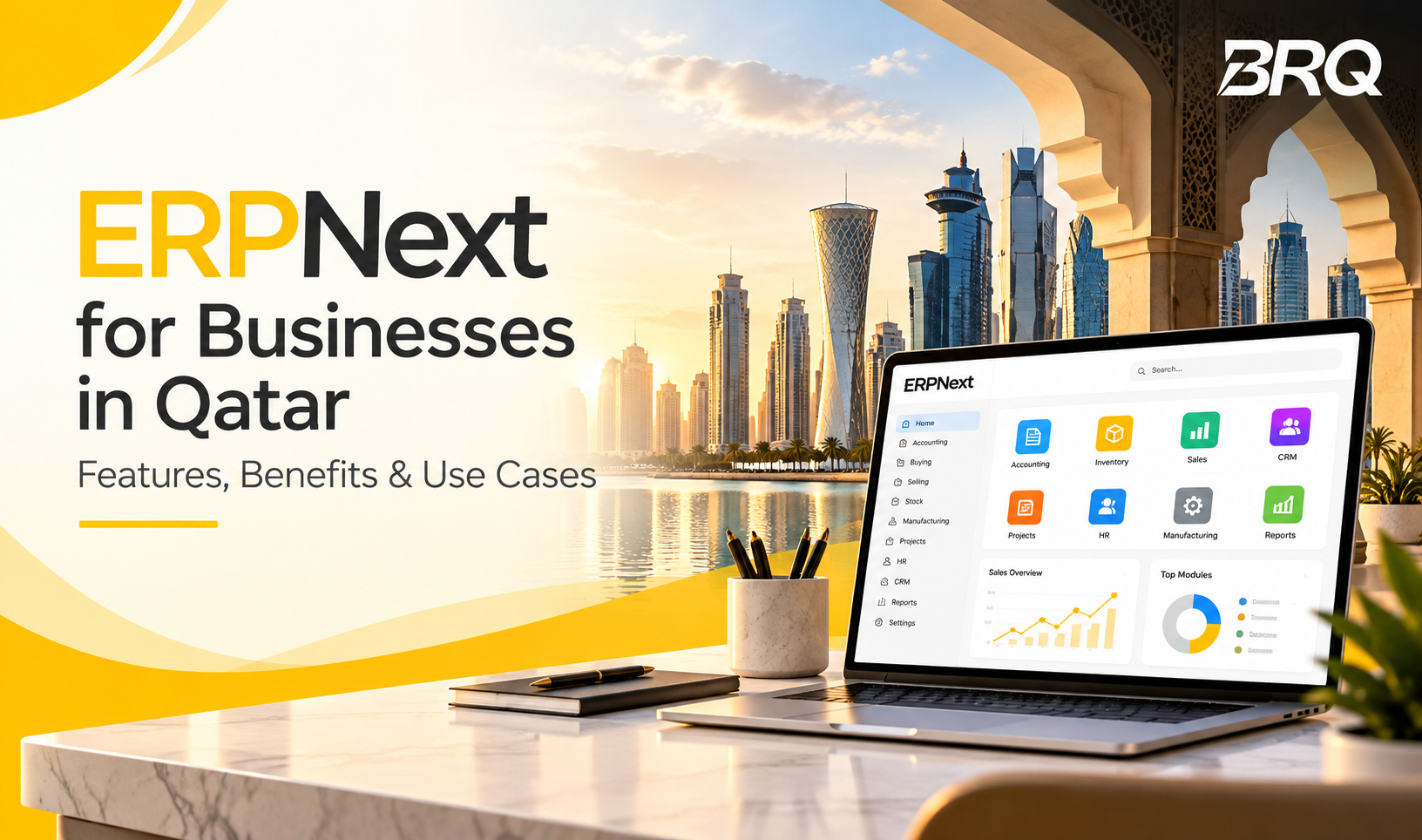
ERPNext for Businesses in Qatar: Features, Benefits & Use Cases
“Let me check and get back to you.”
You might say this when a customer asks about stock, a supplier follows up on payment, or your manager needs a project update. The answer exists but finding it means opening several tabs, checking spreadsheets, and asking a colleague.
If that sounds familiar, this guide is for you.
Exploring ERPNext Qatar solutions starts with a practical question: what would make your working day easier? Whether you own a business, handle accounts, manage orders, or supervise operations, here is how ERPNext could help and how to decide what you actually need.
What Is ERPNext and How Can It Help Your Business in Qatar?
ERPNext is open-source business software that connects functions such as accounting, purchasing, sales, inventory, manufacturing, and projects.
In everyday terms, it helps different teams work from connected business records.
Imagine a Doha supplier receiving an order for equipment. Sales confirms the requirements, the warehouse checks availability, purchasing handles shortages, and finance manages invoicing and payment.
When these activities sit in separate files, everyone needs to check with someone else. A properly configured ERP makes the transaction easier to follow.
Which ERPNext Qatar Features Could Make Your Day Easier?
Different people need different answers from the same system. Start with the concern closest to your role.
| If you often think… | Feature to explore | What it could help you do |
| Can we fulfil this order? | Inventory and sales | Check recorded stock and order requirements |
| Who still owes us money? | Accounting | Review outstanding invoices and payments |
| Where is this purchase stuck? | Purchasing and approvals | Follow documents and approval stages |
| Is this project costing too much? | Projects and accounting | Review recorded work and costs |
| Why are we entering this twice? | Connected workflows and integrations | Reduce repeated entry between systems |
| Who can change this information? | Permissions | Assign access according to responsibilities |
ERPNext provides functions across these areas, including configurable approval workflows and role-based permissions. How they work together depends on your implementation.
You do not need to understand every module before starting. Bring one real example of work that feels unnecessarily difficult.
What Are the Benefits of ERPNext for SMEs in Qatar?
The most useful benefits are often changes your team notices during an ordinary working day.
Answer Customers With Greater Confidence
A customer calls your showroom asking whether an item is available.
If receipts, transfers, and deliveries are recorded consistently, staff have a clearer basis for answering. They can check relevant information instead of relying on yesterday’s spreadsheet.
That can mean fewer uncertain promises and fewer follow-up calls to correct them.
Find Work That Needs Attention
An unpaid invoice or delayed purchase approval is easy to overlook when it sits in someone’s inbox.
Connected records make outstanding work easier to review. Someone still needs to act, but finding the next action becomes more manageable.
Depend Less on One Person’s Memory
Perhaps one colleague knows every supplier arrangement. Another understands all the item codes.
Organized records help other employees follow the process when those people are unavailable. The aim is to make knowledge easier to access while keeping responsibility clear.
See Whether Improvements Are Working
Before implementation, record how long a recurring task takes or how often corrections occur.
Compare the same measures after adoption. Order-processing time, stock discrepancies, and duplicate entries provide more useful evidence than a broad promise of “better efficiency.”
Which ERPNext Modules Should Your Business Start With?
Choose the modules that complete your most important workflow.
| Business type | Useful starting areas | Example concern |
| Trading and distribution | Buying, Selling, Stock, Accounting | Connecting purchases, deliveries, and payments |
| Retail and ecommerce | Stock, Selling, Accounting; POS where relevant | Keeping sales and stock records aligned |
| Professional services | Projects, Selling, Accounting | Connecting work performed with billing |
| Manufacturing | Manufacturing, Stock, Buying, Accounting | Planning materials and recording production |
| Equipment supply | Selling, Stock, Buying, Accounting | Coordinating availability and customer orders |
These are illustrative starting points. ERPNext documentation covers the listed operational areas, but your selected version and configuration should be reviewed.
Try this short exercise:
- Choose one recent order, purchase, or project.
- List everyone who handled it.
- Note where information was copied or checked again.
- Identify where work waited.
- Define what the next person needed to see.
That gives you a practical implementation brief.
One dependable workflow can be a better first milestone than several partially adopted modules.
How Much Does ERPNext Implementation Cost in Qatar?
If your first concern is cost, that is reasonable. You need to understand the commitment before changing how your business operates.
ERPNext is free and open source, but hosting, implementation, and support are separate considerations.
There is no universal price for ERPNext implementation in Qatar. Scope depends on data, workflows, users, locations, integrations, and customization.
Request a proposal that separates:
- Setup and configuration.
- Data cleaning and migration.
- Integrations and custom development.
- Training and acceptance testing.
- Hosting, maintenance, and support.
Then ask: “What will our team be able to do when this phase is complete?”
A clear answer helps you compare proposals by usable outcomes. Also clarify exclusions, change costs, and the work your own employees must complete.
To control the initial scope, prioritize essential requirements and postpone features that do not solve an immediate problem.
Can ERPNext Fit the Way Your Qatar Business Works?
ERPNext can be configured and extended. First, distinguish a necessary business requirement from a familiar habit.
A purchase requiring manager approval above an agreed amount is a clear requirement. Recreating an old spreadsheet exactly may preserve steps your team no longer needs.
Review Standard Functions First
ERPNext supports configurable approval workflows and permissions. Check these capabilities before commissioning custom development.
For each proposed change, ask who needs it, what task it supports, and who will maintain it.
Check Local Operating Requirements
For businesses in Qatar, discuss QAR accounting, foreign-currency purchases, bilingual documents, company structure, and integration requirements.
ERPNext supports multi-currency accounting, but accounts, rates, and transaction handling need appropriate setup.
Review actual Arabic and English outputs. Confirm required accounting and statutory outputs with your advisers rather than assuming they work without validation.
Plan for Exceptions
If an online store sends orders into ERPNext, establish which system owns stock. Decide how cancellations, refunds, duplicate records, and failed transfers will be handled.
A connection is useful only when your team understands what to do when something goes wrong.
Is There a Quicker Way to Get Started With ERPNext?
The shortest practical route is a focused first phase with clear testing.
Bring Real Examples
Provide an actual quotation, invoice, purchase request, or stock report. Explain what employees do with it and where problems occur.
Concrete examples reduce ambiguity more effectively than a long feature wish list.
Clean Essential Data First
Review the customers, suppliers, items, and opening information needed for the agreed scope.
Decide how older records will remain accessible before determining what to migrate. Avoid importing unnecessary duplicates simply because they exist.
Let People Practice Their Own Work
Finance users need to practice finance tasks. Warehouse staff need to practice receipts, transfers, and deliveries.
Include exceptions such as a returned item, partial delivery, canceled order, or incorrect entry.
Agree on What “Ready” Means
Set acceptance criteria before launch. These might include reconciled balances, accurate stock, completed test transactions, and staff able to perform essential tasks.
A smaller first phase can become useful sooner when the process works reliably.
Why Choose BRQ for ERPNext Implementation in Qatar?
You may know what frustrates your team without knowing which technical solution fits.
BRQ’s ERPNext implementation services in Qatar cover designing, extending, and integrating systems around business workflows and growth requirements.
Start With Your Business Challenge
Explain the task that creates repeated work, uncertainty, or delays. Share your current tools so the discussion can focus on the people and systems involved.
Connect Implementation With Daily Operations
Through its ERP implementation services, BRQ offers consulting, setup, customisation, migration, integration, and ongoing support.
Discuss what employees need to do after implementation, alongside the information managers need to review.
Plan Beyond Launch
Include training, maintenance, and support expectations in the project discussion.
Your team should understand the new workflow, its responsibilities, and where to get help when an exception occurs.
Frequently Asked Questions
What Is ERPNext and How Can It Help Businesses in Qatar?
ERPNext connects activities such as accounting, sales, purchasing, and inventory. It can help teams follow transactions without repeatedly assembling information from separate records.
What Are the Key Features of ERPNext for Qatar Businesses?
Relevant features include accounting, inventory, purchasing, sales, projects, and approvals. Prioritise functions that address your team’s recurring operational problems.
What Are the Benefits of Using ERPNext for SMEs in Qatar?
Potential benefits include less repeated entry, clearer records, and more consistent handovers. Results depend on data quality, configuration, and staff adoption.
How Much Does ERPNext Implementation Cost in Qatar?
Costs depend on scope, migration, integrations, training, and support. Request an itemised proposal explaining deliverables and your team’s responsibilities.
Which ERPNext Modules Are Most Useful for Businesses in Qatar?
The answer depends on your business model. Begin with the modules needed to complete one important workflow, then expand after it is dependable.
Can ERPNext Be Customised for Qatar Businesses?
Yes, configuration and development can address specific requirements. Validate accounting, language, document, and integration needs during testing.